Hopeful Mama Still Loves Me

Scoot and me are late to school. I don’t like being late because everyone stares and Miss Primrose expects a ‘reasonable excuse for tardiness.’

Scooter pulls out his pocketknife and strolls to the front, his happy eyes aiming at the wood he’s about to shave into invisible.

“Emma June?” Miss Primrose says.

“I’m sorry, Miss Primrose,” I say, glancing at Frank who’s giving me a half smile. “Scooter had himself a bit of an adventure.”

The class giggles and I want to punch them all in the face. What’s wrong with an adventure? At least the ones that don’t make someone carry a grudge. Daddy said Mama still loves me. There’s hope in that.

I try so hard to remember what happened toward the end of the carnival, but everything is jumbled up like bad scrambled eggs. Carla was in better shape than me, but she fell asleep on the ride home when Mama and Beauty had the fight. I remember fading in and out while they argued. I remember upchucking more than once. There’s nobody to tell me what happened except Mama.

So many questions I wanted to ask Daddy that morning when  I woke up to find Mama gone. The only answers were Daddy’s tears. “We’ll work this out. Don’t worry. We’ll work this out,” he had said. And then his words faded as he shuffled away to his bedroom and closed the door.

I don’t know how to help him work things out any more than I know how to make Mama come home. I might as well try picking up shadows.


Excerpt from The Moonshine Thicket (1928)

Hopeful

Renewal or Regret?

Cono, age eighteen, travels back home to confront his father.

screen-shot-2016-12-29-at-1-41-22-pm


Getting on the train, I’m thankful it’s not crowded. Too many people too close to me is something I’ll never get used to. I find a seat toward the back like I always do. A back up against the wall is a back protected. I need to see what’s going on around me at all times. And like always, when I hop on a train, I hope that my head is still attached when I get to where I’m going; not like our friend, Wort Reynolds who hopped on that train to Clyde Texas, the train that grabbed his head and kept right on going.

         “Ticket please.”

            I turn my eyes from the curved tracks outside my window to the ticket taker. Handing it over, I watch him punch the hole without even looking into my eyes. How many years has he done this, I wonder, and does he like the shoes he’s wearing?

         Home, a place that’s sometimes as hard as cement that you can’t pull your shoes out of. Nevertheless, that’s where I’m heading.

            My ears focus on the sound of the train’s idling, but eager-to-go engines. Where the hell would I be today if I didn’t have those railroad memories chugging along with me, some good and some anything but?

         Just as I’m feeling comfortable that I won’t be crowded, I feel something settling into that worn seat next to me, making itself comfortable but making me anything but. It nudges me. I ignore it and then tell it to go away. It doesn’t listen. The memories want me to pay them a little attention. I know this train is about to pull out. I know this train is taking me to Temple. But my mind and my uninvited seat companion start to take me somewhere else, somewhere I’ve already been before, somewhere I don’t care to go back to. It starts speeding me down the track a lot faster than this train is accustomed and a whole lot faster than I can put a stop to.

         The first memory is safe. It makes me wish, “If only it could have all been this easy.”    

         But past wishes were reserved for the other folks with good seats.    

         Not for me.


Renewal – Excerpt from No Hill for a Stepper

Poor Ol’ Possum

Poor ol’ Possum O’Connell. He didn’t expect the law to show up at his door this early in the morning.

unknown-2


“This ’bout the Beauty Saloon, ain’t it? Didn’t mean to cause a ruckus, but that no-account had it comin’. I fess up. I wasted a good brew when I throwed it on his shirt. I got swole up, is all.”

Mr. O’Connell trained his bloodshot eyes on Sheriff Tobin and then on Giovanni. He ignored Captain Van Riper.

“Not here about that, Possum,” Sheriff Tobin said. “We’re here about the murder of the temperance woman, Marcy Sanders.”

Possum bolted out of his chair, knocking it down. “I swannin’, I never kilt nobody an’ I don’t plan to. I ain’t an eye-fer-an-eye kinda feller,” he said, looking at me.

Giovanni picked up the chair. “Hell, we know that, Possum. Calm down.”

Sheriff Tobin removed his hat and patted the table. “Just sit for a spell and hear us out.”

O’Connell did as told, rubbing his beer gut.

Sheriff Tobin stuffed his hands casually in his back pockets. “Miss Duecker, here, says you remember seeing Miss Sanders, the lady with the yellow scarf, at Menger’s.”

Mr. O’Connell let out a shiver. “Gotta show…show…show y’all somethin’.” He Retreated to his bedroom and returned with a cat under one arm and a yellow bonnet under the other. “This here,” he said, lifting the cat up to his shoulder, “is mine.” He placed Dawg on the floor and held out the bonnet. “This here belonged to Edna. She loved this head wrap. Had it fer many years. Thought about burying her in it, but I jest couldn’t do’er…couldn’t do’er. Wanted to have it to remember her by.”

Van Riper shifted his weight from one leg to the other and heaved a deep sigh.

“Anyhow,” Possum continued, sitting again, “that’s how I come to remember that yeller scarf. Bright as this here bonnet. I’d been drinking Menger corn juice thinkin’ ’bout Edna when I saw that scarf round that woman’s neck. Almost like Edna done sent me a wink, wink, wink from heaven.”

Excerpt from The Last Bordello.


Her Loaded Broom

small

Madam Volvino down the road would have scammed the Wild Bunch. I pictured that dolly-mop charging a lower fee for her bawdy house services and then afterward, jiggling her fat rump straight to the law to collect the one grand in Bounty—one grand for Butch alone.

Only hours ago, Butch, Sundance, Kid Curry, Deaf Charlie, and William “News” Carver trotted off in three different directions. Carver said he’d soon return for Lillie and ride her off into a sunset dream. Like Sundance did with Etta last night. More girls to replace.

I counted again. Expenses, already deducted, included the vast amount of food Reba had cooked up for the entire house, the twenty bottles of French Gosset champagne—one of which I kept for myself—and the Cuban cigars—one of which Reba kept for herself. And, of course, the girls’ wages.

The familiar wide-hipped, narrow-waisted woman sidled through the swinging doors and into the kitchen, balancing a silver platter piled with dirty dishes. “Lawd have mercy,” Reba muttered.

“Too much on your plate?” I asked, laughing at my pun.

“Them wily bunch might be good at train robbing, but they ain’t worth nothing when it comes to sprucing up behind themselves.” Reba set the tray on the counter and then plunked into the chair closest to my desk in the kitchen’s corner. She stared at my grin. “What? It ain’t funny, Fannie Porter.”

“Isn’t funny,” I corrected. “Besides, this is the last for the Wild Bunch. The whole country’s chomping at the bit to catch them, especially the Pinkerton Agency. Gang’s splitting up.”

“So they says.” Reba grinned and shook her head. “I tells you what is funny. You chasin’ a known killer round the house with a loaded broom.”

“Wasn’t funny at the time.” Last night, Kid Curry, too liquor-seasoned to keep his chin above his neck, broke two of my rules. First, he entered my bedroom without permission, and then he tore my silk sheets with his spurs before I managed to shoo him out. “He promised to send new ones.”

“Mmm. And I’s growing catfish in my garden.”

Excerpt from The Last Bordello.


Emma June remembers

I don’t feel any different after gulping Brandon’s swill. All I feel is happy to be away from him and doing something new.

Carla points to the sign.

‘Madam Zola’s Expert Fortune Teller

Past, Present, Future

Crystal ball gazing, Palm reading

Tarot Cards.’

We don’t care there’s a line waiting outside the door. We sneak to the back where no one will see us then lay on our stomachs. Carla peels up a side of the canvas so we can have a good listen to what Madam Zola’s tells her paying customers.

The first customer asks where she can find her lost dog.

The second voice is Beauty’s.

 I hadn’t thought about Mama all day.

Now, I have to poke my arm to keep from crying.


From my upcoming novel, The Moonshine Thicket.

Uncle Will’s fortune

screenshot-2016-12-20-11-18-09

Cono’s pony, Polo

I ride him up to the front of the house, but start slowing down when I see a car pull up in front of Ma and Pa’s. Not just any car, but a brand new four-door 1931 Cadillac that I know Uncle Will paid through the nose for.

         “Cono!” I hear Aunt Nolie yell, “Come say ‘hello’ to yer Uncle Will.” I ride Polo over to Uncle Will, as he’s getting out of his fancy car wearing his fancy suit, five dollar Mallory hat and carrying his fancy walking stick. Since he’s married to Ma’s sister, Aunt Oler, I know I need to be polite, but it’s hard to be since he’s always such a horse’s butt. His money never helps us out none. I’m not sure it helps him either ‘cause it sure doesn’t make him a nice feller. Last time he came over he looked at me and said, “Why Cono, ye haven’t grown an inch. You better watch out or yer little sister’s gonna catch up with ye, Ha ha ha.” I didn’t like it when he said that, not one little bit.

         Polo and I ride up close to him he says, “Well, hello there Cono..”

            I’m just waiting for another report about how I’m not growing and I’m about to say, “Hello sir” but don’t get the chance. He walks over to me and pulls me right off Polo with his fancy walking stick. “Well, I’ll be damned” is what I’m thinking; the shock of it all doesn’t let me think of anything else. Uncle Will laughs. I can’t believe it, but he reaches in his pocket and thumb-flicks me a shiny penny.  

         “Save it up fer a rainy day there, young fella.”

            I pick it up off the ground and mumble, “Thank you, sir.”

            Aunt Oler and Aunt Nolie don’t pay me no mind, they just go on talking. I get up, grab Polo by the reins and walk slowly back towards the house. I don’t want Uncle Will to know that underneath my hat, my dander is up. So what if he’s got an oil rig named after him? So what he just gave me a shiny new penny? It ain’t like I’ve never seen one before! As far as I’m concerned, Uncle Will’s just a short, fat, King’a Fancy Man and I wish I had his Cadillac and he had a wart on his butt. I’m just gonna go put that penny in my cigar box until I think of something to do with it.

            Probably buy some paper to wipe my butt with.

From my novel, No Hill for a Stepper.

Fortune

You Would be 87 today

I wrote this shortly after my father died in 2009. (Happy Birthday, Daddy)

Dear Dad,

I write.  My eyes blur.  I see a cowboy hat with a cowboy underneath it.   You’d say,  “This hat’s worth a lot more than what’s underneath it” .  We knew better each time you said it. You are worth more to me than you’ll ever know.

When I was in the Brownies, we went to a father/daughter banquet at the middle school and your job was to identify my feet under the stage curtain.  I sat behind that curtain for only a short time when I heard you say, “is that you Carolyn?”. “That’s me Daddy” I said. You found my feet before I knew where they were going to take me.  

In Girl Scouts, you told me I had made a fabulous speech in front of a large audience when in fact, I had stood there, a frightened girl in uniform, with all my words stuck in my throat.  I was silent and scared, staring into the crowd of strangers. You were the only one who heard my silent words, like they were loud and clear and perfect. You said I did just fine.  You made me not hate myself that night.

You threw that football with me in the front yard and always encouraged me.  You taught me how to drive.  You said to never forget where my break was.  

You taught me how to love my dogs, how they held our hearts and souls within them, in case we forgot where and who we were.  Thru them and other things, you taught me that your heart was sensitive and kind.  

You told me bedtime stories, like the three little bears.  “AND THERE SHE IS”, you’d say and I’d laugh like it was the first time I’d ever heard it.

And you were the one who taught me how to pray.

Just a couple of weeks ago, I was at your house putting on my hands wraps for my boxing class.  You wanted to know how fast I was so you speed-drilled me by putting your hand up. Your past boxing memories were still alive.  You were always in my corner, pulling for me, taking care of me when I was hurt.  My Dad, my cornerman.

On Father’s Day while you laid in bed, I brought you the painting I had done of a cowboy silhouette.  You looked at it and said, “that’s me riding off on my last sunset.”  We all knew you were ready for that ride.  

20161103_130229

I believed you when you told me you would always look after Pat and I after you had gone.  You said, “I always take care of my babies”.  And now I hear you say, like you’ve said a thousand times before,  “if I tell you a rooster wears a pistol, look under it’s wing.”

You didn’t plan the first part of your life but you lived it, felt it, analyzed it and learned where you were going next.  You wanted a life with stability, you met my mother and you lived the next 6o years on a level ground.  And then?  When it was time for you to die?  Somehow you figured out how to put all your ducks in a row and be buried on your anniversary.  So Dad, when I get sad I will know where you are, together again with my mother, exactly where you are supposed to be.  

And as your grandpa, Ike, always said with his sarcastic grin, “ well, aren’t you smart.”
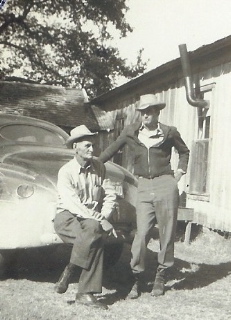
ike-and-cono

Dad on right with his grandfather

And <to my son and daughter>:  Grandpa would want me to remind you of a few things.

1.  trust yourself and learn first to be your own best friend. 

2. whatever you choose to do in life, make sure you love it.

3.  take care of your money

4.  <Son>, it’s not time to go, it’s time to dance.

5. <Daughter>, stay away from hairy legged boys.

And as I was laying in the front room of your house, the night before you died, I realized that the times you hugged me from the outside to the in had ended.   From this point on, your hugs will be from the inside to the out.  And I will feel them always.

You put the “spirit” into my soul, Dad. You were my greatest teacher.

And as you always said, “the cream in the pitcher always rises to the top.”

And there, you are.

With a love that never ends, 

Carolyn.

(No Hill for a Stepper is my father’s story about growing up in the Great Depression with an abusive father. My dad broke that chain of abuse)
Letter to a dead friend

In the 1930’s, a sad seven-year old Cono writes a letter to his deceased friend.

screenshot-2016-12-17-11-10-36

Cono with his little sister

Dear Gene,

            I hate it that you’re dead and that those stupid doctors in Roby couldn’t fix you to save your life. We had more things to do, you and me. More wars to fight with the other boys in the neighborhood and more of our own fights to have just between the two of us, the ones that were so much fun but made us dog-tired and bruised afterward. Even though you were just a little older, but a lot littler, you always got the best of me. We never gave up. You’d just say, “Cono, ye tired yet?”

            “Yeah,” I’d say.

            “How bout’s you and me stop fightin’ for the day?”

            “OK,” I’d say.

            And that’s what we’d do. We’d get up, dust off our britches and stop for the day. But we’d never give up. Boys in Rotan, Texas never give up. That’s what you said.

         Don’t feel bad about being dead. I think some of us are dead, when we’re still alive anyway. Or maybe it’s just that some of us aren’t completely born yet, like we’re waiting for a little peace and quiet to show up so we can take our first real breath.

         I’m sorry I couldn’t make you better and I’m sorry that nobody could take me to visit you in the hospital. Maybe if you had been in there a little longer, I could have found a ride. I know you never gave up, so there must have been something else that caught your eye.

         Things are growing on me Gene and I’m not talking about inches or new hairs. Things are crawling under my skin. I’m feeling antsy and mad and even a little bit not like myself. I wouldn’t be a bit surprised if someone were to holler, “Cono!” and I’d just keep going the other direction thinking my name was George or something. My hands clench more often than they used to. My teeth do too. Just the other day, I caught myself staring in the bathroom mirror. I was about to brush my teeth, but my jawbones were moving in and out and I realized I was clamping down so hard with my grinders that a tooth brush didn’t have a chance to get in to do its job.

         I’m writing to you Gene, Fishing all my words outta my truth bucket. And when I’m done? I’ll send this letter up to God Jesus, so he can read it to you. Better yet, maybe I’ll go someplace real quiet, where nobody else on this earth can hear. And I’ll talk real loud, so you can hear me all the way up in heaven. And if someone else up there happens to hear? It’s okay. I know they won’t tell anyone since they’re dead too. Besides, you’ll know it’s me. I’ll be the one flicking marbles with my pocket knife!  

            I sure wish you could tell me what it’s like up there. When I went to the revivals with the Allridge boys, they told me that Jesus has made a room for dead people and you’ll get to live there forever with Him. What does your room look like?

            I wanna know if you’ve made any friends and if Jesus lets you wrestle and fight with them like we used to do for fun. The revivalists say that we’ll get to meet our loved ones again when we die. But what if I die when I’m a hundred and I get there and you’re still only eleven years old. Are you gonna sit on my lap and tell me Jesus stories? Ha Ha. It’s good to know that you have a room up there in heaven, although I’m not sure I believe everything they tell me at those revivals.

         Gene, I want to kill my Dad. Send him right up there to heaven, where maybe you can teach him a few things, like how to be nice to me. But then, I guess it would be too late. Unless, he was Jesus and got alive again to came back to do something good. That’ll be the day.

         Anyhow, I sure hope you’re real happy up there. I hope you get to throw the football and play checkers and flick marbles. And say? If you see my Uncle Joe and our friend Wort Reynolds, tell them I say, “Hello.”

         Your friend,

            Cono

         P.S. – Wort’s the one without the head.

(Excerpt from No Hill for a Stepper)


Eggs against Prostitution and Alcohol Reform

(1901) Meta learns, while attending the Women’s Christian Temperance Union rally, that soiled dove Sadie has snuck out of the bordello and is hiding in the background. As Meta listens to the speakers advocating for women’s rights, and the men become angry at the progressive words, something unexpected happens.

unknown

Excerpts from The Last Bordello,  Chapter 28: Eggs of Folly

Meta Duecker

“Due to the efforts of the WCTU, the age of consent has been raised from thirteen to fifteen. We strive for even higher,” Miss Fisher <Minnie Fisher Cunningham, Women’s Right Activist> said. “Every day, the newspapers report acts of violence against women and remind us of men’s incapacity to cope successfully with this monster evil of society.”

“What are you saying, missy? We men ain’t capable?” The man’s words elicited angry comments from the crowd.

Miss Fisher hesitated before she continued. “We know you men are hardworking gentlemen. For women, education is the key, both in and out of the home.”

Some women clapped. Others squinted in puzzlement as if the thought of learning something other than child-rearing had never occurred to them. Her words enlightened me and affirmed my goals.

A man, close to the front, pumped his fist. “My wife don’t have time for more learning. We got six kids needing supper on the table.”

Querulous male voices erupted from the crowd.

“Why do women prostitute themselves to the abnormal passion of man?” Miss Fisher continued. “Because they are poverty-stricken, destitute above temptation, and driven by necessity. They sell themselves, in marriage or out, for bread and shelter, for the necessities of life. How can we blame them? They have no other recourse but to live in a society that dictates what they—we—can and cannot do. To solve this problem, we demand that women be allowed to exercise their inherent, personal, citizen’s right to be a voice in the government—municipal, state, and national. Then, women will have the power to protect themselves.”

“We men protect our women just fine,” a man shouted. Other men yelled their agreement.

Mayor Hicks stepped to the podium, his lips pursed. “Enough of your heckling. Save your disagreements for editorials in the newspapers. She has a right to free speech.”

“So do we,” someone yelled back.

The mayor banged a fist on the podium. “These women are invited guests. By God, we will show them our Southern hospitality.”

The raw egg came from nowhere. It narrowly missed the mayor’s head before landing on the bandstand floor. He squinted, scouring the crowd.

Poor Mrs. Fenwick held a shaky hand over her mouth.

Miss Fisher reached below the dais and pulled out a speaking trumpet. “The true relation of the sexes can never be attained until women are free and equal with men,” she said, her determination thundering above the chaos.

The second egg hit the podium dead center. The crowd either gasped or laughed. Some men took hold of their wives and scurried them away, while the women in black remained steadfast in their chairs behind the podium.

…  The yolk running down the front of the dais did not deter Miss Fisher. She stood firm, her voice amplified by the speaking trumpet. “As the great Susan B. Anthony said, whoever controls work and wages, controls morals. Independence is freedom. Independence means happiness. Therefore, we must have women employers, superintendents, legislators. For moral necessity, we must emancipate women, pull them out of prostitution, and safeguard our country. Thank you.”


A book launched Texas style…

Aside

Since I have “friends” now, I’m reblogging this post from 2011. It was a special day for me, indeed.

No Hill for a Stepper book launch

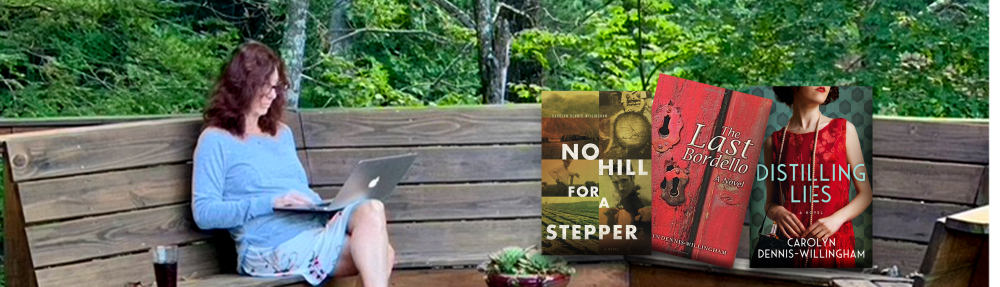
Carolyn Dennis-Willingham


No Hill for a Stepper was  launched Texas style with  James “Slim” Hand as our  special musical guest.  Singing the songs of Cono’s era that would have made Bob Wills and Gene Autry proud, the music was the perfect foreground for our hill country setting. What an evening!  The word for the evening was “surreal” as I saw the efforts of the last 3 1/2 years come to the end of just a beginning. I cannot begin to thank all of the attendees who supported me although I certainly tried! Plus they donated sacks of coins that I will give to the winners of the students in Bell County for the “No Hill for a Stepper” essay contest.  Payin’ it forward as they say.

To the crowd of over seventy people, my heartfelt acknowledgment of my father was this:

“No Hill for a Stepper”  is my father’s story. While my mother, during her lifetime, was thirsty for life, she spoke mostly about her present and her future.  My father focused more on his past.  There were reasons he did so.  First, because he wanted my sister and I to know how very different his life was compared to ours. Pat and I didn’t have to pick lambsquarter for our meals and we didn’t have to live in a dugout for our shelter.  But the other reason he talked so much about his past, especially in his later years, was that he had something to resolve before he died.

As many of you know, my father was very much aware of this novel. A pen guided my hand in response to the things he recounted to me. Dad talked. I listened and wrote and wrote and and I recorded. Never in my life would I have been able to make up his story on my own.

Cono is here tonight, along with my mother.  They are here in the photos and in the songs that James Hand is playing. They are here in my spirit and in my heart. Together, Mom and Dad are where all questions are answered and all things are resolved. They are now where things are no longer discouraging but instead, they are where things are copacetic.  

My father did not live long enough to see the final product. So Dad, here it is – the final product I told you I would finish. “If I  tell you a rooster wears a pistol, look under its wing.”

And then, my fellow supporters joined me in singing Dad’s favorite song, “Home on the Range,” loud enough for him to hear.