Being offended by social injustice is Meaningless if you don’t do something about it.
Do Something!
Reply
Being offended by social injustice is Meaningless if you don’t do something about it.
No matter your walk in life, we have all been affected by racial diversity. Some find it threatening. Others find is socially and culturally mesmerizing and exhilarating. For the purpose I am pursuing, let’s narrow it down to the white and African American culture.
While starting my new novel, my fear is the voice inside my head. It says,”How can you, a white woman, write about the African American experience in 1963? How could you possibly understand?”
Here’s my goal. To write an entertaining novel for all age groups but especially for young adults who may not know important historical facts about the Civil Rights Movement- which I will weave into the novel. I want the reader to take pause, reflect, and think about their actions going forward.
Big goal, huh? But I sincerely believe that understanding the past will put us in a better position for the future.
Here’s the premise to the novel:
In 1963, while staying with the unhinged friend of her deceased grandmother, a 14 yr old white girl from Texas meets a teenaged “Negro” boy from Alabama and learns first hand about racial injustice.
I am doing tons and tons of research. I have read “Black Like Me” by John Howard Griffin and The Fire Next Time by James Baldwin.
So here’s how you can, hopefully, help me.
I appreciate any and all suggestions!
Thank you for reading and responding!
Carolyn
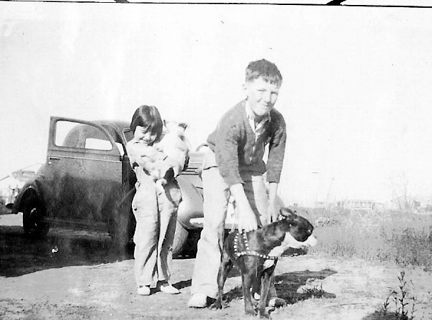
Cono Dennis and his sister, Delma
1934: We walk into the barber’s shop and Dad shakes hands with Mr. Kindle. The place looks pretty much the same as Grady’s in Ranger, but instead of a boxing poster, there’s a framed picture of President Roosevelt. Something else different too. There’s a colored man standing in the corner holding a rag. Dad walks up to him, shakes his hand and says, “How ya doin,’ H?”
“I’m jest fine, Mr. Wayne. How ‘bout yerself?” They shake hands.
“Any better ’n I’d be dead.”
“Well, that’s fine then, jus’ fine,” H. laughs.
“H., this is my boy, Cono.” H. bends down, looks me square in my eyes and says, “We’ll, it’s a real pleasure Little Dennis, a real pleasure.”
I like how he’s Squatting so he can see my eyes. Like we’re playing on the same team. I don’t have to look up to him and he doesn’t have to look down on me. I stare back into his eyes where I can see right into the middle of him. What I see is safe and comfortable. So I say, “I ain’t never met a real colored man before.” I hear Dad laugh.
“‘S’at right?”
“Yeah.”
“Yes, sir,” corrects Dad.
“Yes sir,” I say.
“Well, Little Dennis, I’ve never met a young man so strong and smart lookin’ as you.” Dad gets in the barber’s chair and H. pulls up a stool to start shining Dad’s old black shoes.
I like the way H. looks at me, like I’m worth a jar full of quarters.
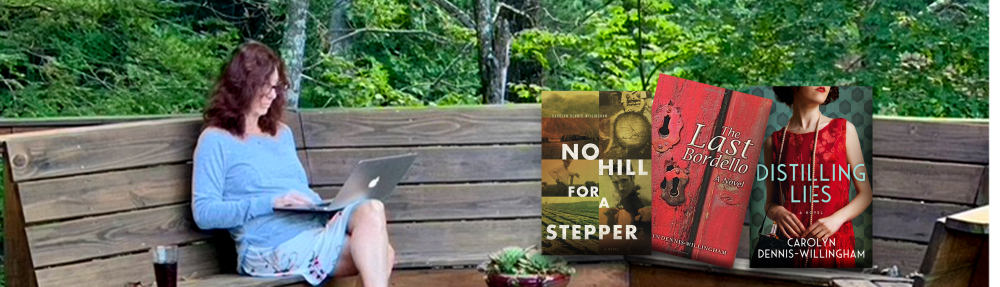
Excerpt from No Hill for a Stepper
I don’t want to answer any more of her all-the-time questions. So I ask, “Where’s Scooter?”
“Behind on his school work. No surprise there.” She laughs, but I know her son lagging behind in this world rubs blisters of worry under her skin. “He’s home with Leonard,” she continues. “I’ll swannee, my poor husband doesn’t have much hair left from the strands he pulls out trying to help Scooter.”
“Hmm,” I say, looking at Choppers.
Kids at school say Scooter’s grain elevator doesn’t reach the top of the silo. That he acts more like a six-year-old than a thirteen-year-old. They don’t know Scooter like I do. He might not be the brightest penny in the cash box, but I’ve known him all my life. He has more grain than most of the numbskulls in Holly Gap, Texas and Scooter’s worth more than the whole lot of them. Wherever Scoot skips, bounces or walks, goodness sprouts in the footsteps he leaves behind. Without Scooter, everything would grow dead.
Excerpt from The Moonshine Thicket
Daily word prompt: Criticize
For the longest time, I was tired of my black and white, tired of everyone bickering about who was smarter, who was better. I felt boring and tired, frustrated and snarky. Then, after I nudged a fallen little boy back to upright and I licked his skinned knee, my first colorful stripe appeared! The second came after I pulled a mouthful of leaves from an acacia tree and, when I noticed the soulful eyes of a walking 4-legged loner, I gave my meal to him. Over time, my stripes became so colorful, my friends wanted to know my secret. Now, Arnie Armadillo is aqua, Scotty Skunk is sky blue and silver, Gracie Gray Wolf is green, and … well, you get the picture.
Anyway, being kind is easy and nobody bickers anymore.
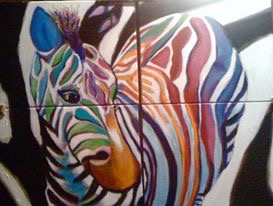
painting by me, CDW
On a scale from one to Ten on the happiness meter, I’d say that I’m a fairly consistent eight. But, unfortunately, the needle of my frustration o-meter’s is perilously close to the danger zone. Why?
My core belief system, my moral code has not only been challenged, but also marginalized by the flip of a narcissistic man’s hand.
Anyone who has read some of my past blogs know who I am and what I stand for. And, what I acknowledge as my truth, isn’t about to change now. In fact, now, that select politicians have dipped their poisonous swab into my ideology canal, the results will come back as they always have, and this time, with a vengeance. I will continue to fight for the oppressed, for the rights of humanity and stand up against tyranny.
It has come to my attention that many folks did not understand the reason for the “Women’s March.” That’s okay. Hopefully, after so much has been written, they now understand. It wasn’t a protest against, but a march for. A march toward a better place for all humans.
How is that a bad thing?
Yes, I heard that somewhere in the world, there were acts of violence at the women’s march. The one I read about was of a pro-life supporter who was spit upon for her beliefs. Outrageous, in my opinion. I am not pro abortion in any way. I would have done (and tried) anything to have given birth to my two wonderful children who have made me a grandmother.
I am for the right to choose. I know, some of you might not understand this, and it’s too hard to explain in this post.
I also believe that some of the signs carried at various marches were “inappropriate.” Yet the ones who carried them had as much right to do so as the pro-life marchers.
Because, in that march, there was room for everyone, Republicans and Democrats alike who believed in the rights of humanity.
Now, here is my frustration. Four million plus people across the world marched to show their support for equality and since then, my mind has returned to vague memories of the sixties and the more prominent ones in the seventy and eighties. So why didn’t the ERA (Equal Rights Amendment) pass? The Equal Rights Amendment (ERA) was a proposed amendment to the United States Constitution designed to guarantee equal rights for women .
“Gender equality, also known as sex equality, gender egalitarianism, sexual equality, or equality of the genders, is the view that everyone should receive equal treatment and not be discriminated against based on their gender.[This is one of the objectives of the United Nations Universal Declaration of Human Rights, which seeks to create equality in law and in social situations, such as in democratic activities and securing equal pay for equal work.” (see wikipedia for more info on the 9th amendment to the constitution and also the 14th which finally gave rights to same-sex couples.)
The National Organization for Women, N.O.W., founded in 1966, worked toward equal pay for women. How has that worked out so far?
I recently turned, gulp, sixty. Do I really have to do this all over again?
I painted this on the first day of the Iraqi war and named it “Peace Bubbles.” (I sold this painting and believe it is hanging on a wall in a yoga studio in NYC)
Whatever traditions you celebrate this season, I hope your life is filled with peace, acceptance, grace, hope, kindness, joy and LOVE.
All the best to you, my blogging buds! – Carolyn

“I’m going to bet on MY ‘underdog-ness’ and give this a shot. Some might sigh a bit when they see a fellow blogger try to promote their work. But try we must.” CD-W
In a previous post titled, The Shape of our Being, I mentioned how our experiences shape our humanness, including the Carolyn Being (a work in progress). My “shape” shows up in my novels. In this excerpt from The Last Bordello, Sadie, a prostitute in a 1901 bordello, escorts the virtuous Meta (who accepted Madam Fannie’s offer to be the bordello’s pianist) on a tour of the city.
And truly, thanks for hanging with me!
“Meta, I know this is your first time to a big city. I want to be fair. There is something I want you to understand.” She paused, gathering my attention. “People in town know I’m a painted lady, a prostitute. Or, as some like to say, a lowly whore.”
“But—”
Sadie held up a hand. “Being seen with me is almost as bad as being a prostitute yourself. People will judge you. Your reputation could be tainted by merely being seen in my presence. I truly don’t want any harm or ill will to come to you. I don’t want you embarrassed by my company.”
Perhaps this was Aunt Amelia’s concern, what she wanted to tell me. If the public thought less of me for playing the piano at a bordello, I didn’t care. Weren’t even prostitutes and their customers entitled to the magic of music?
Unlashing Sadie’s grasp, I stepped a foot to the side. “Sadie, I appreciate your honesty. Now,” I said, my grin widening, “shall we walk back arm in arm like schoolgirls?”
Sadie’s white teeth glistened in the February sun. “Yes,” she said, interlocking an elbow with mine. “Onward to the next stop.”
Excerpt from an Amazon review:

Elizabeth Cady Stanton, women’s right activist
Growing from a child into a young adult are powerful years. The “big” events and experiences during that period stick with us.
I would like to share something with you because it’s important to me.
In a previous post, I mentioned how each of us has our own prevailing awareness — experiences that have formed our humanness.
In my case, the Carolyn Being.
At eight-years old I was told I was going to hell for not being Baptist. I tried to stand up for myself. It was hard. I was outnumbered. In tears, I ran home to my mother.
What I learned: It hurts to be judged by your faith.
A popular football player in high school pushed and mocked a blind student. “What are you doing?!” I shouted. For a second, I wondered who’s said that. I was not the confrontational kind and my words shocked me. They also felt good.
Later, that same year, a young girl with Down Syndrome climbed up my body like I was a grand oak tree, clinging to me with comfort while others gaped, appalled. I smiled. I loved her strong and loving arms.
What I learned: Never poke fun at the physically or mentally challenged.
A friend in early 1970’s “confessed” he was gay. I said, “But you’ll still drive us around, right?”
What I learned: A good friend is a good friend no matter what their sexual preference.
In the late seventies, a friend used the “n” word in front of me. I told him to never do it again.
What I learned: Friends may not share your values.
I learned about poverty while student teaching in a low income center across from the housing projects.
What I learned: We are not born in equal environments.
I witnessed a “clean cut” UT student, rip the metal trim off of the side of an old car that wasn’t his. I confronted him while my friend found the bar’s bouncer.
What I learned: It’s disrespectful to destroy another’s property.
After many more experiences were added to my Prevailing Awareness, I decided to enter the field of Special Ed then changed my major to Child Development.
So, I taught bias-free education to my teachers and at local and state conferences. This theme carries over into my novels.

From my experiences, I learned to stand up for those who are picked on, faced with injustices, scrutinized and criticized for being “different.” I learned to stand up to the oppressors who try to crush another’s dignity in order to feel temporarily (and falsely) empowered.
That’s how I roll.
How about you? Do you have a particular experience/experiences that molded the shape of your BEING?

… of the United States, have elected a new president and I spent most of yesterday in the dark, literally.
Do I blame those who voted differently than me? Of course not. Our forefathers gave us that right.
The ground beneath me (perhaps yours) has cracked and shifted. Like a desert with no water? I hope not.
Oh say can you hear?
–how the voices on both sides were loud, strongly opposing, and severely divided.
On Tuesday night, did we form a “more perfect union?”
Do you hear Lady Liberty’s song, the lyrics still tucked in my brain after singing them almost every day in my elementary school music class?

No, not anymore. Not anymore.
We have chosen a different kind of candidate. “In order to form a more perfect Union”?
Oh say can you feel? Why I am sad? Bear with me here.
I follow politics, but I am not a politician. I am not skilled in the workings of politics nor do I hold a public office.
But I do hold something else and have carried it for a long time.
I was a quiet hippy kid in high school when our psychology class took a field trip to the state school that housed our mentally impaired. After other classmates had shooed her away, a five-year-old girl with Down Syndrome climbed up my (then) skinny body like I was an oak tree. We clung to each other as if life depended on it. For me, it did. Her grip so tight, the attendants had to peel her away from me. But I never forgot her, that little girl who helped me choose what path to take.
In high school, I avoided conflict. In speech class we had a student who kept to himself. He wore thick glasses and could read only if the text was an inch from his face. One day we had a fire drill. My speech class, including this student, left the building and united with others on the school grounds. A popular football player pushed the boy, laughed, called him a name.
“And the rocket’s red…” glared.
The quiet, non-conflict Carolyn tugged his sleeve and yelled, “Hey! What are you doing!”
I had shocked myself. But I had discovered that indignity was too powerful for me to ignore.
Mr. Trump brought back that memory. To me, he was that bully who not only mocked that reporter but pushed my classmate with the thick glasses.
At UT Austin, I went from studying Special Ed to Early Childhood. After tugging my professor’s arm, I was allowed to student teach at a Title XX low income center where I interacted with children of all races and religions. I learned.
And the man said, “I like kids. I mean, I won’t do anything to take care of them.”
I graduated, ran a Child Development Center, taught my staff about bias-free education, and how to implement it in their classrooms. I spoke at state and local conferences on why teaching tolerance was so important to, not just our country, but to our world.
Intolerance scrapes, tugs and wrenches my insides.
People with disabilities, African Americans, Mexican Americans, women, the LBGT community, children, illegal immigrants, Muslim Americans, (the list continues) all of us, want to see a better world, have a better life.
Some used to proudly say America is melting pot. I believe we are a beautifully tossed salad and, in our giant bowl, each ingredient adds a special flavor.
I have to believe that we are not a union of intolerance. I do not want to believe that intolerance motivated people to vote for Trump. But if he won the electoral vote because his voters wanted change in our government, I can accept the decision. Because that reasoning trumps intolerance.
We are all huddled masses yearning to breathe free. Let’s just huddle a little closer to one another and let freedom to ring for all.

 Carolyn Dennis-Willingham