The unenlightened neighbor

till.jpeg

Olvie pours herself another cup of Folgers while I start the pancake mix. “I think that was the door, Olvie.”

“Come in, Wise-Guy,” Olvie yells.

“Well, that was pleasant,” Tanner says, wearing a clean pair of “underground” railroad pants.

I pour circles of batter into the hot skillet. “What?”

“Man came charging toward me from across the street. Said I didn’t have any business being here. Guess he doesn’t like Negros.”

“Asshole,” Olvie mumbles.“That’s because he doesn’t like himself, that stupid son of a bitch.”

Pondering her words, I wonder if Olvie is really smarter than the rest of us. Mom and Dad told me people are often scared of things they don’t understand. And instead of trying to figure out what they’re afraid of, they resist anything new, anything different. Mr. Roberts must not have any Negro friends. If he did, he wouldn’t be afraid of a teenage boy.

“What did you tell him?” I ask.

“Nothing. I ignored him.”

“Why’d you do a thing like that?” Olvie says. “Should have told him off.”

“And why would I do that?” he says. “I don’t want trouble.”

Olvie huffs. “You sound like your uncle. ‘Don’t wants to cause any trouble, ma’am. Yes’m, anything you want, ma’am. Ain’t no good stirring the pot, you see.’ Ugh.”

“You think Uncle Elias should stand up for himself? Like I told Chicken Coop, he’s old school. He’s still afraid of the white man’s world.”

“Oh, and you’re not?” Olvie says.

“Oh, yes’m, I is alright,” he says in dialect. “Jes’ try nots to show it.”

Olvie stops in mid Chuckle. “Elias still thinks garlic hanging over a bed will cure a cold. If you tell him otherwise, he won’t listen. Speaking of, how’s that finger, Wise Guy. Need me to chop it off? You hung those tools up real nice in the utility room. I can find my saw easy now.”

Tanner squeezes his hand. “No thanks. Think I’ll hold on to it for a while.”

This makes Olvie laugh. She has a good laugh, one I’d like to hear more often.

Excerpt from my work in progress set in 1963.


NOTE: The photo is of Emmett Till who reminds me of my character, Tanner Ford. This novel will be in honor and memory of Emmett.

Out of his comfort zone (until the movie comes on)


“Well, well, well,” says asshole pimply-faced Kent behind the glass window. “Thought you were leaving for the summer.”

How could the tolerant Mr. Pryor hire this racist?

“Two tickets.” I thrust the money in the hole.

“Two? Where’s your friend?”

I don’t want to get Tanner in trouble. I also want to stand my ground. “He’s behind me.”

Kent squints at Tanner. “Now you’re friends with a …” He looks behind him. Mr. Pryor faces toward us. He’s chatting with an older lady with bluish hair. “Friends with a colored? He your boyfriend?”

“Let’s go, Chicken Coop,” Tanner whispers behind me. “Ain’t worth it.”

“My friend and me came to watch a movie. Now, sell us the goddamn tickets, Kent.”

There is that look of anger and there is a look of hatred. Kent’s wearing both. He hands me the ticket.“Next,” he says through clinched teeth.

Tanner finds a place to sit in the back of the theater. I go for popcorn and cokes. When I return, he asks if we can put a couple of seats between us.

From my Work in Progress about a biracial friendship in 1963.

Outlier

Learning with challenges


Scoots’ hand in mine, we walk home from school. His other hand blows a new harmonica, one of many Miss Helen bought at Johnson’s Variety.

He’s getting better at playing “Has Anybody Seen My Gal.” He misses notes sometimes, but now I can almost sing along without hour-long Pauses between the words.

“You like playing, Scoot?”

He takes the harp from his mouth and wipes it on his sleeve like a real musician. “Like DeFord Bailey.”

“Who’s Difford Bailey?”

“DeFord Bailey. Best ever. That’s gonna be you someday, Scooter,” he says in a Frankish-enough voice I have to laugh. “DeFord had polio. Polio. Like me.”

“You never had polio, Scooter.”

“DeFord learned anyway,” he says, straight in my eyes.

And then I know. Scooter understands that, unlike most folks in Holly Gap, Frank believes in his abilities to learn.

Scoot drops my other hand and uses both to play us home.

Excerpt from The Moonshine Thicket


Staying with a Fruitcake

Sitting on the leopard print living room couch next to Gladys, I know I’m living in an episode of The Twilight Zone. Not because Gladys sits in the exact same spot wearing the same flapper dress from when I got here three days ago. And not because Olvie hasn’t bothered to move her. I’m in The Twilight Zone because I have to spend the next few weeks living with a fruitcake.

I peek out the front window. Olvie’s at it again. Just a few minutes before, like she’s done every morning, she told me to “stay put” until she comes back inside with the newspaper. And like every morning, she won’t pick it up until she sees Elias Ford heading her way on his walk to work.

Olvie’s shuffling down her sidewalk towards the curb wearing her moo-moo and striped yellow and black socks. She bends down to pick up the newspaper. He must be getting close. Yep. I see him now. Mr. Ford has stepped into the danger zone, too close to The Property of Olvie P. Crazy.

Like always, Mr. Ford tips his shabby hat and attempts to hurry past.

Like always, Olvie steps in front of him with the familiar finger point and the poke, poke, poke to his chest.

I don’t get why she doesn’t like him. What’s the Controversy anyway?

Yesterday morning, Crazy Olvie had forgotten to close the front windows. I heard her ask Mr. Ford if she could spit on his shoes. “It won’t take long,” she’d said, almost politely.

I wonder what she’s quacking to him about this time. That his shoes need polishing? That his rusty lunch pail should be thrown off a cliff? That the only reason he still lives around the corner is because my daddy spent “too much time” repairing his house so the city wouldn’t tear it down? Mr. Ford lives in what some ignorant people call, The Black Pocket—a small thicketed area that folks like Dad fought to keep intact. Including the ten or so residents.

Mr. Ford shakes his head. I bet right now he’s wishing he’d moved after all. His expression reminds me of Tom Robinson in the movie To Kill a Mockingbird and the thought makes me sad.

I get in Gladys’ face. “Let me tell you. I’m not happy about being here either. So there.” She doesn’t respond, of course.

I must be catching her loony bug. Perhaps I won’t last a few weeks. Maybe not even day four. I ponder where to go and what to pack before I run away.

Excerpt from a work in progress.

Oh, how I miss you, Italy

19543_1244492190753_1813016_n.jpg

painting by me, Carolyn Dennis-Willingham

I miss the language (I’ve forgotten most of what I’ve studied)

I miss the people who say what they mean and mean what they say.

I miss the culture, the arts, the music on the streets.

I miss the architecture and the oldness of things.

I miss the food with its all-fresh ingredients.

I miss the incredible chalk paintings on the streets of Firenze (Florence).

And more.

Wait for me, Italy. I’ll be back!


Cono meets a “Colored Man”


screenshot-2016-12-17-11-10-36

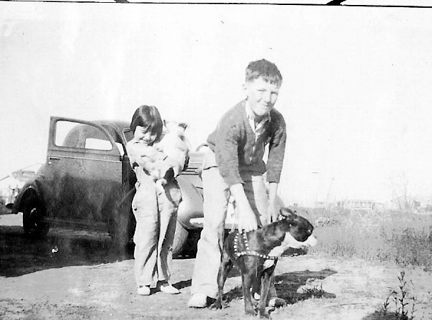
Cono Dennis and his sister, Delma

1934:  We walk into the barber’s shop and Dad shakes hands with Mr. Kindle. The place looks pretty much the same as Grady’s in Ranger, but instead of a boxing poster, there’s a framed picture of President Roosevelt. Something else different too. There’s a colored man standing in the corner holding a rag. Dad walks up to him, shakes his hand and says, “How ya doin,’ H?”

  “I’m jest fine, Mr. Wayne. How ‘bout yerself?” They shake hands.

   “Any better ’n I’d be dead.”

  “Well, that’s fine then, jus’ fine,” H. laughs.

 “H., this is my boy, Cono.” H. bends down, looks me square in my eyes and says, “We’ll, it’s a real pleasure Little Dennis, a real pleasure.”

 I like how he’s Squatting so he can see my eyes. Like we’re playing on the same team. I don’t have to look up to him and he doesn’t have to look down on me. I stare back into his eyes where I can see right into the middle of him. What I see is safe and comfortable. So I say, “I ain’t never met a real colored man before.” I hear Dad laugh.

   “‘S’at right?”

   “Yeah.”

  “Yes, sir,” corrects Dad.

 “Yes sir,” I say.

“Well, Little Dennis, I’ve never met a young man so strong and smart lookin’ as you.”     Dad gets in the barber’s chair and H. pulls up a stool to start shining Dad’s old black shoes.

I like the way H. looks at me, like I’m worth a jar full of quarters.

Excerpt from No Hill for a Stepper


Have you earned your stripes yet?


For the longest time, I was tired of my black and white, tired of everyone bickering about who was smarter, who was better. I felt boring and tired, frustrated and snarky. Then, after I nudged  a fallen little boy back to upright and I licked his skinned knee, my first colorful stripe appeared! The second came after I pulled a mouthful of leaves from an acacia tree and, when I noticed the soulful eyes of a walking 4-legged loner, I gave my meal to him. Over time, my stripes became so colorful, my friends wanted to know my secret. Now, Arnie Armadillo is aqua, Scotty Skunk is sky blue and silver, Gracie Gray Wolf is green, and … well, you get the picture.

Anyway, being kind is easy and nobody bickers anymore.

How many stripes do you have?

19543_1244549752192_1601212_n

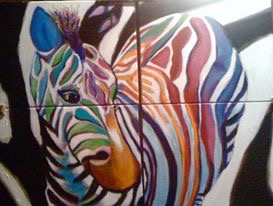
painting by me, CDW

Keep Your Poisonous Swab away from MY Canal

On a scale from one to Ten on the happiness meter, I’d say that  I’m a fairly consistent eight. But, unfortunately, the needle of my frustration o-meter’s is perilously close to the danger zone. Why?

My core belief system, my moral code has not only been challenged, but also marginalized by the flip of a narcissistic man’s hand.

Anyone who has read some of my past blogs know who I am and what I stand for. And, what I acknowledge as my truth, isn’t about to change now. In fact, now, that select politicians have dipped their poisonous swab into my ideology canal, the results will come back as they always have, and this time, with a vengeance. I will continue to fight for the oppressed, for the rights of humanity and stand up against tyranny.

It has come to my attention that many folks did not understand the reason for the “Women’s March.” That’s okay. Hopefully, after so much has been written, they now understand. It wasn’t a protest against, but a march for. A march toward a better place for all humans.

How is that a bad thing?

Yes, I heard that somewhere in the world, there were acts of violence at the women’s march. The one I read about was of a pro-life supporter who was spit upon for her beliefs. Outrageous, in my opinion. I am not pro abortion in any way. I would have done (and tried) anything to have given birth to my two wonderful children who have made me a grandmother.

I am for the right to choose. I know, some of you might not understand this, and it’s too hard to explain in this post.

I also believe that some of the signs carried at various marches were “inappropriate.” Yet the ones who carried them had as much right to do so as the pro-life marchers.

Because, in that march, there was room for everyone, Republicans and Democrats alike who believed in the rights of humanity.

Now, here is my frustration. Four million plus people across the world marched to show their support for equality and since then, my mind has returned to vague memories of the sixties and the more prominent ones in the seventy and eighties. So why didn’t the ERA (Equal Rights Amendment) pass? The Equal Rights Amendment (ERA) was a proposed amendment to the United States Constitution designed to guarantee equal rights for women .

“Gender equality, also known as sex equalitygender egalitarianismsexual equality, or equality of the genders, is the view that everyone should receive equal treatment and not be discriminated against based on their gender.[This is one of the objectives of the United Nations Universal Declaration of Human Rights, which seeks to create equality in law and in social situations, such as in democratic activities and securing equal pay for equal work.”    (see wikipedia for more info on the 9th amendment to the constitution and also the 14th which finally gave rights to same-sex couples.)

The National Organization for Women, N.O.W., founded in 1966, worked toward equal pay for women. How has that worked out so far?

I recently turned, gulp, sixty. Do I really have to do this all over again?