Rising from the Ashes

9fb39d20b85b98d7a252d3d5d22322a0

The girl from yonder when she slept

On pillow soft

Had dreams she kept

Beneath the down of feathers laced

With tears she saved from when she wept.

And stored within the liquid flow

Were thoughts of life

But dreams of gold

And memories of stories shared

Were kept inside

But never told.

 When the morning timely rose

She stretched her arms in firm repose

And told herself in solemn vows

She would not dwell upon her woes.

-MWD (aka, me)

a74966078377d9d6d134d434d47e42de

 Flames of courage.

Note: MWD is a character from one of my novels but “her” poetry never made it to the final product. This poem is only one of many.


‘Righting’ Disturbing Childhood Incidents in our Novels.

Simple, really. Life experiences affect the way you write. And, as authors, you have the power to change, modify and/or right the pains you may have endured when younger.

Sometimes, when writing, you don’t even expect a terrifying childhood event to pop into your consciousness. Especially if that incident has nothing to do with the story’s plot line. But memories pop in, don’t they? When that happens, your fingers peck down on the keys and type a different scenario, a different outcome.

I won’t go into the gory details. But I’d like to share a disturbing memory.

It’s my fault. That’s what I thought as a ten-year old.
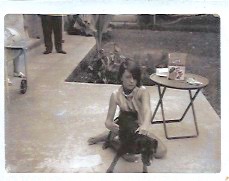
scan-21-1

Me with Buffy

After my friend discovered our missing eighteen-year-old Cocker Spaniel dead in the creek, she gave me a new puppy for my birthday, part Lab, part Beagle.

‘Buffy,’ named after the girl in 60’s show, Family Affair, was still young–two, I believe. I let her come with me across the quiet residential street to play with neighborhood friends. She was so happy before she ran in front of a parked car. The driver didn’t see her. (To this day, I accuse him of speeding, especially when he was driving past a group of kids  playing in a front yard.)

Not disclosing the images still in my mind, my dad called me from the vet clinic. “Carolyn,” he said, his voice choking with tears. “Since she’s your dog, you have a decision to make. She can live with three legs or we can put her to sleep.”

Back then, I had never seen a dog with three legs. My young, limited brain had to make a choice. Guilty Carolyn said, “Every time I look at her, I’ll remember my mistake.” Compassion Carolyn said, “I don’t want her to suffer.”

“Put her to sleep,” I whispered into the phone, because I didn’t have the life experience to tell me otherwise.

Later in life,  when I had children, I sat in the living room in our new house, my five-year old daughter next to me on our sofa. As we watched my baby-grand piano being set up, she said, “Mommy, why does it only have three legs.”

Spontaneously, I said, “Because, sometimes, that’s all you need.”

Then, I thought of Buffy.

scan-7

Now, fifty years later, I’ve met many three-legged dogs.

In my latest novel, Distilling Lies, the plot line doesn’t require a dog. Even so, Emma June has one.

Page 283:

Beating ourselves up kept us from moving forward. When Choppers lost his leg, my guilt stungso much I could barely look at him. Then I realized his sadness hadnothing to do with losing a limb but from my lack of attention. He wanted me to love him regardless of how many legs he had.

And there is was, a theme relevant to my novel. The new outcome put a different kind of smile on my face. Buffy (Choppers) is happy with three legs.

One way or another, aren’t we all three-legged dogs doing the best we can?

Traveling Mercies (Anne Lamott),

Carolyn

Writing to heal-   http://www.apa.org/monitor/jun02/writing.aspx via @APA

How to Turn Traumatic Experiences Into Fuel For Your Writing  https://shar.es/1Efxfr via @sharethis
Where Do Inspirations Come From?

IMG_3407.JPG

If Give You Give A Mouse A Cookie, he’s going to ask for a glass of milk. When you give him the milk, he’s probably going to ask for a straw….”

That’s what happened to me, but in a dream.

So, I took that morsel, ran with it, and didn’t “return” until five years later.

Hmm? How to make this brief?

We own our family homestead.

homestead 004

My great-great grandparents set their belonging on the land in the 1840’s and said, “das ist gut.” And it was. And it is.

In my dream, the essence of me stared into an old photo. In the frame, the couple turned to one another and smiled. Then, the screen door opened. The farmer stood in the doorway to greet his wife, but couldn’t enter.

And that’s what started the process of writing The Last Bordello.

As written in Chapter Two:

Most nights, I see Papa in my dreams. In a slower-than-life pulse, in a not-so-common four-count measure, he smiles as he grabs the knob of our screen door and opens it to enter. His movement repeats. He smiles and opens the door. Smiles and opens the door. Each time, he never enters. He never falls.

But Papa did fall; collapsed before crossing our threshold into the house his neighbors helped him to build. Four years ago now, all of the notes of Papa’s life faded away with his last breath. A stillness so loud that my ears still burned.

If only Papa hadn’t died.

I’m not living in 1901 anymore. I’m no longer in a bordello, in a lunatic asylum, or attending  a Women’s Christian Temperance Union or Suffrage meeting.

I’m in 1928. So far, it’s the cat’s pajamas. (The Moonshine Thicket– working title)

screenshot-2016-08-02-08-36-31-copy

screenshot-2016-08-02-08-55-26

Dear writers, listen to your dreams!

A book launched Texas style…

Aside

Since I have “friends” now, I’m reblogging this post from 2011. It was a special day for me, indeed.

No Hill for a Stepper book launch

Carolyn Dennis-Willingham


No Hill for a Stepper was  launched Texas style with  James “Slim” Hand as our  special musical guest.  Singing the songs of Cono’s era that would have made Bob Wills and Gene Autry proud, the music was the perfect foreground for our hill country setting. What an evening!  The word for the evening was “surreal” as I saw the efforts of the last 3 1/2 years come to the end of just a beginning. I cannot begin to thank all of the attendees who supported me although I certainly tried! Plus they donated sacks of coins that I will give to the winners of the students in Bell County for the “No Hill for a Stepper” essay contest.  Payin’ it forward as they say.

To the crowd of over seventy people, my heartfelt acknowledgment of my father was this:

“No Hill for a Stepper”  is my father’s story. While my mother, during her lifetime, was thirsty for life, she spoke mostly about her present and her future.  My father focused more on his past.  There were reasons he did so.  First, because he wanted my sister and I to know how very different his life was compared to ours. Pat and I didn’t have to pick lambsquarter for our meals and we didn’t have to live in a dugout for our shelter.  But the other reason he talked so much about his past, especially in his later years, was that he had something to resolve before he died.

As many of you know, my father was very much aware of this novel. A pen guided my hand in response to the things he recounted to me. Dad talked. I listened and wrote and wrote and and I recorded. Never in my life would I have been able to make up his story on my own.

Cono is here tonight, along with my mother.  They are here in the photos and in the songs that James Hand is playing. They are here in my spirit and in my heart. Together, Mom and Dad are where all questions are answered and all things are resolved. They are now where things are no longer discouraging but instead, they are where things are copacetic.  

My father did not live long enough to see the final product. So Dad, here it is – the final product I told you I would finish. “If I  tell you a rooster wears a pistol, look under its wing.”

And then, my fellow supporters joined me in singing Dad’s favorite song, “Home on the Range,” loud enough for him to hear.