Just stop with the hacking already

Most of the people I know don’t speak Japanese and I certainly can’t write it. So when you hacked my website, I wonder what you said. Did it benefit you? Did you get a little smirk on your face at the little joke you played on me? Well, let me tell you, I put my armor on, did a little behind the scenes work, and now I’m back swinging on a chandelier. So take that, you slacker hacker!

Lying Tongues

Before the spring carnival, the worst thing that happened to my family was the amputation of Choppers’ leg five years before. Then, after the three of us adapted to one less appendage, drastic change returned to the easy kind. Like cutting my hair into a fashionable bob and wearing shorter dresses. Or Miss Helen coming up with another name for her moonshine and having to glue new labels on all the Mason jars.

Anticipated changes, like spring turning into summer, were rehearsed, old friends. So when the 1928 March page was forever ripped off our Coca-Cola wall calendar, the upcoming months were supposed to be a blueprint of the ones before. I thought I knew what to expect and ignorantly planned accordingly.

I pictured Betty, Mama’s best friend, showing me how to bloom wild and carefree like the Texas bluebonnets and Indian blankets. And, like the wildflowers, Betty would provide our cross timber and prairie land with much-needed color. She would continue to add pizazz to our small town and laugh at the rolling eyes of gossipers.

I believed Mama would drive us to Mineral Wells to picture shows, and Charlene and I to church picnics. While amongst the not-so-holy-rollers, we would place bets on which Methodist would be the first to get ossified on Miss Helen’s moonshine. Then we’d up the ante and guess which upstanding churchgoer would be first to holler at Sheriff Gunny Gibbons to “keep up the good work” — which really meant, “thanks for ignoring prohibition.”

Summer would turn into a heat that bore into our Texas bones like a drill pumping for oil. Except for keeping an eye out for rattlers, the heat wouldn’t stop us. The Brazos River     was at our ready for splashing and squealing longenough to bring our boy talk to a brief halt. And on those warm summer evenings, the fireflies would almost provide us enough light for reading. These were my expectations, easy days when a calamity meant the latest Sears and Roebuck catalog was overdue on its delivery.

I counted on the everyday rhythm of sounds that, so deeply rooted in my marrow, had synced with myheartbeat. Miss Helen’s moonshine distillery thumping and hissing next door. Her son, Scooter, calling out to me, “It’s gonna grow, Emma June,” after he buried one of her kitchen utensils or some other what-not in their yard. Jazz music floating out from our Victor Victrola when Mama played her favorite records. The steady ticking of our grandfather clock. Cricket music soothing me to sleep. The hazy rumbling away of Ol’ Bess as Daddy left for the dairy each morning before the first rooster crowed. All familiar, promising sounds.

But, as I wore naive like the latest fashion, all normalcy came to a grinding halt. The crickets stopped chirping. The clock inside our once-respectable house stood still and silent. Because the snakes didn’t wait for summer to coil at our feet. They came on carnival night, flicked their lying tongues, and took Mama with them.

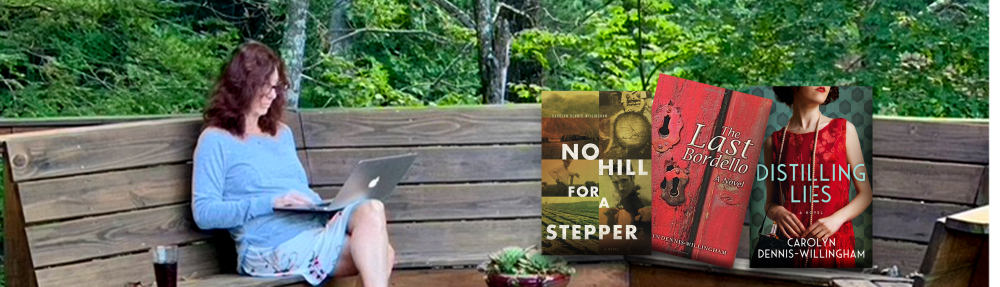
(Excerpt from Distilling Secrets by Carolyn Dennis-Willingham)

photo image credit

What Kind of World?

They watch.

They listen.

* Sammy’s dad is proud of how he almost pushed that bus off the side of the road with his truck. He’s proud because he got confirmation that it was okay and well done. The confirmation of “I love Texas” was all he needed. The boy sees the look of satisfaction on his father’s face. There must be something good about bullying and intimidation.

* The man at the podium mocks a reporter for his disabilities, his inability to use his arms. People laugh. Sarah, the little girl with cerebral palsy sits in a wheelchair, watches.

* I was only two when my mommy said in our native tongue, “It’s okay. We left the bad guys behind. We will be safe here.” But the place was crowded, dirty. People in uniforms yelled. Then they took Mommy away. She hasn’t come back for me. I’m forgetting what she looks like.

* My grandma lives in Kenya. I’ve been to her yellow house and have seen the animals run free on our drives outside of town. Now I’m worried because the President says Grandma lives in a shithole.

* Name-calling is okay now. “He” calls people “irrelevant,” “stupid,” “clown,” “crazy,” “nut job,” “dopey,” “dummy,” “nasty.” So why is my third-grade teacher so mad at me for calling Billy a sucker?

* I try to concentrate on the computer screen where my fourth grade teacher is teaching us about science. But why should I listen if science isn’t real? I hear my parents talking from the living room. They say the president seems to hate everyone who doesn’t look like him or think the way he thinks. They wonder how this man can’t wrap his arms around the saddened, or allow a child touch his head to feel his hair like Obama did. He doesn’t make snow angels in the snow with his children or go to his child’s or grandchild’s recital. Does he have grandchildren? Does his like them? Does he like me? Apparently not.

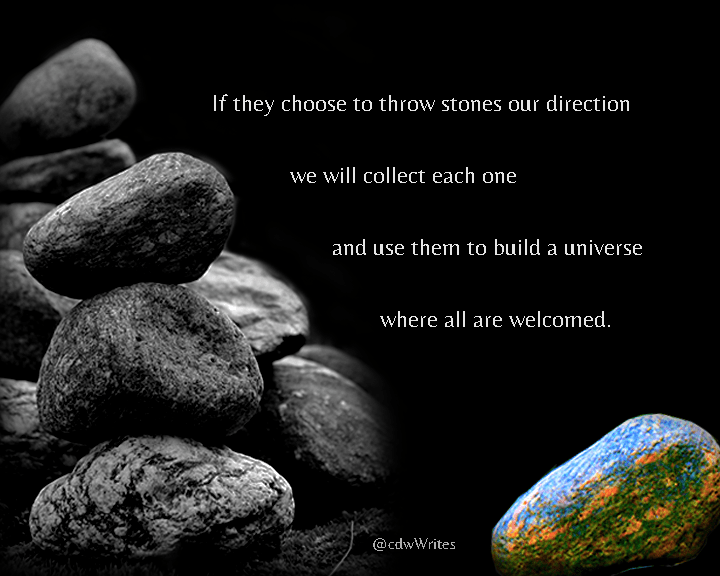
This author thinks about the children. I grit my teeth, a specific spot on the left side. The headache continues.

photo credit 1

photo credit 2

Quick Tip – Don’t ‘BEE’ an “on the Nose” Writer

I’ve been writing a very long time so when my learning curve takes a leap, I have to share it.

Writing too “on the nose” (a term recently introduced to me by my editor) is a sure-fire way to spoil the readers’ experience. They will be robbed of the very thing they are craving – subtext and subtleties inside the story. Readers want to make their own interpretations and we have to remember they are smart enough, intuitive enough, to do just that. Readers want the reading experience to be alive. And, they want it in technicolor.

Here is an example of where my editor caught me.

My writing: I don’t care about money. I just want to feel safe, loved. I want my friends to like me. I want to ferret out the truth so my family returns to normal. 

Editor: Sounds too simple and on-the-nose. You want to imply/show these things rather than say them outright.

What she forgot, or was too kind not to mention, my POV character would never have said “I want to ferret out the truth.” That was me, the author, talking.

On-the-nose writing is unnatural, and unexciting. And if the reader recognizes the words as author’s instead of the character’s, the novel becomes merely a piece of reading material.

Here’s an example of a too-on-the-nose internal dialogue::

I’m lucky Sears and Roebuck delivered my silk stockings on time. Bare legs wouldn’t be nearly as impressive, besides I want to be in style. As I pull them on, I think about tonight. I’ll find a quiet place where Samuel and I can be alone. Will I let him kiss me?

Now for the more colorful version from my Work in Progress. Notice the subtext:

I slide the stockings up to my thighs, roll the tops, and give a word of thanks to the Sears and Roebuck Gods for the delivery. The screen in my head flickers with thoughts of tonight’s picture show, me as the lead actress — Samuel sitting next to me on a well-chosen bench; the carnival lights catching the silk shine on my legs when I ease my dress up to my knee.

Think subtext – I like to think of them as hidden messages.

How boring it would have been if Dorothy Boyd (Renee Zellweger) had told Jerry Maguire (Tom Cruise) “Yes, I love you. I’ll take you back.” But she didn’t. She said that famous line, “You had me at Hello.”

Think natural, yet colorful dialogue (unless they are sitting on a therapist’s couch, people rarely say exactly what’s on their minds).

Think of better visual clues: “She pulled the sweat-soaked shirt away from her skin and looked up. Nothing but sun. Even the birds were too hot to fly.

Think of a colorful world where information is not allowed to be dumped into the readers laps.

If it sounds a bit like “show vs. tell,” it is. But WITH the added bonus of rich dialogue, subtext and subtleties.

As my editor told me with metaphor – Let the readers enjoy the roller coaster ride on their own. If there is someone behind them (the author) telling them where the drops or loops come up, the thrill is gone.

HERE is a great article that gives excellent examples of how the screenwriter of This is Us avoided “on the nose” by using subtlety and subtext.

HAPPY WRITING!

Look for me on instagram for additional wrapped goodies (including a trash bag for the posts you don’t like) 😜

image credit
Internal Rewards

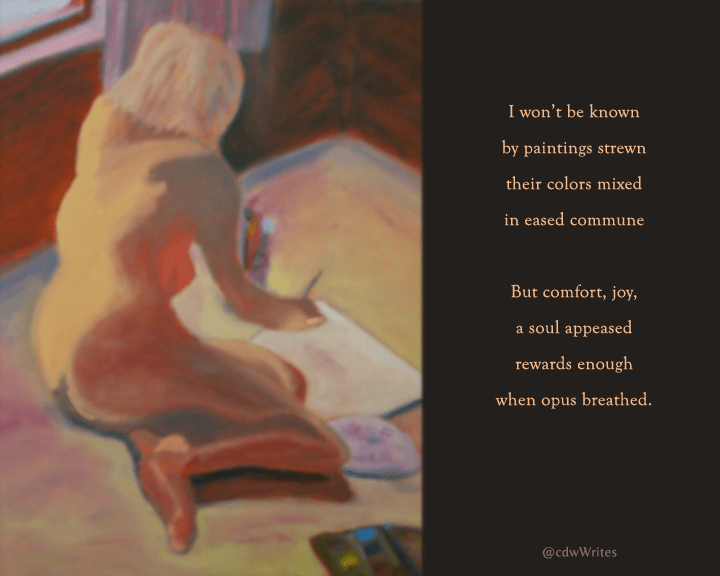
Each of my paintings is a time marked and stamped with a memory. There are so many canvases stacked in corners of my house and even the worst ones are difficult to part with. Throwing them away is like saying that moment didn’t count. But it did. The process filled me. Now, as I work on my manuscript, I visit them on occasion, blow a little dust off their corners. 

We Get to Choose

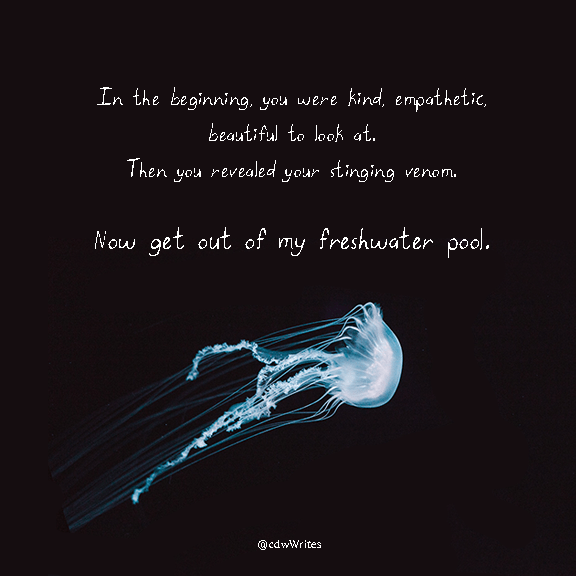
Yep, felt a bit spunky when I wrote this. But don’t we all know people who, through our eyes, their kindness fades or we see something in their character that we can no longer tolerate? We get to choose our friends, our partners. If our relationship with them causes us to feel emotionally damaged, we also get to unchoose them. Cool, huh? Easy? Not always. Still, life is short and we all deserve to be treated with kindness and respect. Because that’s what we give, right?

Where Are You, America?

For me, and perhaps for you other Americans as well, this July 4th has been very different from all the others. I miss being able to travel from “sea to shining shore” to see fireworks, to have BBQ’s that include more family and friends. I miss the president whose mission was to unite us instead of divide us. Tonight before bed, I will watch Hamilton then clothe myself in strength and wake with the determination that America will secure for us a better tomorrow.⁠