Like a Rodeo Bull

From The Last Bordello (1901). Madam Fannie Porter talks to Reba, her best friend and co-worker.


th-7

Miss Reba (as I picture her)

Reba’s voice brought me out of my doldrums.

She stood just inside the kitchen, her hip holding open the screen door. “Freshness growing from the ground up. Picked and served like He made possible.”

“You woke up from your nap.”

“Thought I died of a soft underbelly?”

“You? Hell, you might be eleven years older than me, but you’ve got more vim and Vigor than a rodeo bull. Just as stubborn, too.”

“Speakin’ a that. Tell ’em, Fannie. You don’t wants to beat a path around that ponderin’ bush. They needs to know.”

I followed her motion to come back inside. “You’re right, Rebie. We’ll tell them when they come down to eat.”

“We tells ’em? Ain’t no we about it. No, ma’am. That jawin’ session be yours.”

This time, it wouldn’t be a regular house meeting that consisted of reminders about chores that needed doing, client appointments, and Reba’s nagging them to douche and keep their pee-shes clean. This powwow would be different.


Sadie, before becoming a prostitute

At age fifteen, Sadie Sated Timothy – from The Last Bordello.

th-19

It started the day Timothy and me sat on a gentle slope on the banks of Geronimo Creek between the honey mesquite and Texas spur grass. He’d snuck a bottle of whiskey from home and had been thoughtful enough to bring crackers and a small chunk of cheese to our Sunday afternoon picnic. I was smitten with the boy, the twin to my best friend, Kat.

He spread the blanket and, for the first time, I spread my legs. The weight of him, slight as it was, felt like a made-to-fit blanket.

He was finished before I had the chance to feel him inside of me. “I might only be fifteen,” I said, laughing. “But I don’t think that’s what it’s supposed to feel like.”

Offended at first, Timothy managed a grin. “Then I guess we need to try it again.”

Then I caught sight of the ugly housedress that Lucinda, my so-called mother, wore almost daily. Ugly like her character. Ugly like her words. Stupid like her Bible-mouth that preached how Jesus would protect her yet Lucinda wouldn’t get up on a ladder if her life depended on it.

She split us apart, yanked me up by the hair, and ruined my favorite dress as she dragged me home.

“You miserable bitch,” I screamed. “Just because you couldn’t keep my father at home doesn’t mean I have to be a spinster. I love him! Love him! Any time Timothy wants me to pleasure him, I’ll be willing and ready.”

Lucinda slapped me. I slapped back, harder. She fell on the warped flooring of our kitchen and dabbed a finger at the corner of her bloodied lip.

For the next two weeks, we didn’t speak. Still, I heard her mumble on occasion, “Ticktock, ticktock. They’ll put you under key and lock.” I didn’t pay attention to those words. I should have.

Meeting Dixie Dupree!

I rarely write a review on Amazon, but after reading The Education of Dixie Dupree by Donna Everhart, I had to. Here it is:

51ep1ndvxel

Readers will learn from Dixie Dupree’s education!

Like every great book, the first chapter of The Education of Dixie Dupree grabs the reader by the collar and makes us yearn to know more. Loved this book!

The author, Donna Everhart, blew so much life and guts into her eleven-year-old protagonist that Dixie Dupree leaped off the page and into my heart from the very beginning. I identified with this young girl’s sassiness and grit, wagged my finger at her mischievous tongue, and, later, screamed at her to speak up and let the words flow.

Set in a small town in Alabama in the late 1960’s, the story revolves around Dixie and her relationship with her mother, father, brother and uncle. Written in first person point-of-view, Dixie shows us the good in her life, and how to survive when it’s anything but.

Some readers may find parts of Dixie’s suffering too troublesome to read. But her suffering is also part of our education. What reader can’t identify with the emotions of guilt, anger, and sadness that may lead to (hopefully temporarily) damaging our being?

But these emotions do not depict the whole story. The Education of Dixie Dupree is also about determination, insightfulness, warm hugs, resolution, and wholeness.

Dixie Dupree deserves a degree for her education—and her creator, Donna Everhart, deserves to be wearing a cap and gown and handed a framed diploma for writing this outstanding novel.

The Shape of our Being


Growing from a child into a young adult are powerful years. The “big” events and experiences during that period stick with us.

I would like to share something with you because it’s important to me.

In  a previous post, I mentioned how each of us has our own prevailing awareness — experiences that have formed our humanness.

In my case, the Carolyn Being.

At eight-years old I was told I was going to hell for not being Baptist. I tried to stand up for myself. It was hard. I was outnumbered. In tears, I ran home to my mother.

What I learned: It hurts to be judged by your faith.

A popular football player in high school pushed and mocked a blind student. “What are you doing?!” I shouted. For a second, I wondered who’s said that. I was not the confrontational kind and my words shocked me. They also felt good.

Later,  that same year, a young girl with Down Syndrome climbed up my body like I was a grand oak tree, clinging to me with comfort while others gaped, appalled. I smiled. I loved her strong and loving arms.

What I learned: Never poke fun at the physically or mentally challenged.

A friend in early 1970’s “confessed” he was gay. I said, “But you’ll still drive us around, right?”

What I learned: A good friend is a good friend no matter what their sexual preference.

In the late seventies, a friend used the “n” word in front of me. I told him to never do it again.

What I learned:  Friends may not share your values.

I learned about poverty while student teaching in a low income center across from the housing projects.

What I learned: We are not born in equal environments.

I witnessed a “clean cut” UT student, rip the metal trim off of the side of an old car that wasn’t his. I confronted him while my friend found the bar’s bouncer.

What I learned: It’s disrespectful to destroy another’s property.

After many more experiences were added to my Prevailing Awareness, I decided to enter the field of Special Ed then changed my major to Child Development.

So, I taught bias-free education to my teachers and at local and state conferences. This theme carries over into my novels.

tolerance


From my experiences, I learned to stand up for those who are picked on, faced with injustices, scrutinized and criticized for being “different.” I learned to stand up to the oppressors who try to crush another’s dignity in order to feel temporarily (and falsely) empowered.

That’s how I roll.

How about you? Do you have a particular experience/experiences that molded the shape of your BEING?
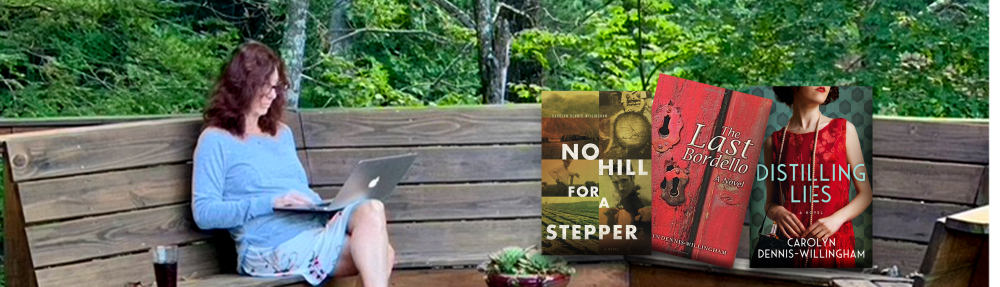
 

What Author Doesn’t…

love a great review!
Customer Review

5.0 out of 5 stars You’ll really enjoy this thrilling work of historical fiction, October 17, 2016
This review is from: The Last Bordello: A Novel (Paperback)

In 1901, Meta Duecker boards a train in her hometown of Fredericksburg, Texas, bound for the big city of San Antonio. She’s looking for higher education, and finds it in ways she didn’t expect.

At Madam Fannie Porter’s Boarding House, Meta finds refuge from a storm, but is soon caught up in a maelstrom at the intersection of women’s rights, prohibition, and free enterprise.

THE LAST BORDELLO is a thoroughly enjoyable novel. Dennis-Willingham deftly constructs a page-turning whodunit from a colorful pageant of historic characters and a well-researched portrayal of a young city shaking off its frontier dust.

As Meta finds herself employed playing piano at a brothel, she finds herself in many ways. This is a spellbinding account of colorful times, but the things we learn about tolerance, loyalty, and compassion are timeless.

Without giving anything away, the book’s title is not what you think. You’ll understand it soon enough. Let’s just say the perseverance and determination of women like Meta and Madam Porter is a lesson for today.


The Red Bordello Door-To Enter Or Not?


If you choose to go inside…

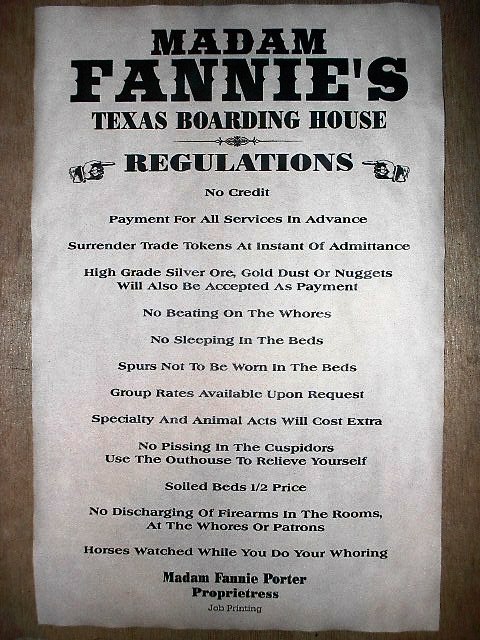
Madam Fannie Porter will answer your knock, her  head tilted back and a hand on her protruded hip. If you are a customer, she’ll first point out her list of rules and if you don’t follow them, the ratchet of a shotgun will show you the way out.

kgrhquokpe54boqlbbojkssnk_3


Then, she’ll point to one of her soiled doves –Chubby Greta from west Texas with her big brown eyes and no nonsense attitude; timid Lillie who grins but rarely exposes the gap where her tooth had been knocked out by a brute; Sassy Sarah with her flaming red hair and ample bosoms. Then there’s Sadie. Well, Sadie …

If you are a lost young woman steered to the wrong “boarding house,” Madam Fannie will keep you safe. She might also offer you a job as the bordello’s pianist.

But perhaps you choose not to enter.

You may be against vice, the Social Evil, the Grand Wrong. Then go to the public forum in Alamo Park. Hear Minnie Fisher (Cunningham) speak out on women’s rights. Listen to Women’s Christian Temperance Union‘s Texas president, Helen Stoddard, speak out against prohibition. But prepare yourself. Texans likes their beer.

Whichever choice you make, know this. The Last Bordello is not a novel about what goes on behind closed bedroom doors (okay, perhaps a tad), nor is it merely a whodunit. It’s about powerful women at the turn of the twentieth century who fought for their standing in life. While some found prostitution to be their only means of survival, other women fought for equal rights.

The Last Bordello depicts the struggle and determination of both sides.

Oh, and I suggest NOT entering Southwestern Insane Asylum.

It is 1901. So, would you enter or not? Are you curious about what’s inside? Appalled? There’s no wrong answer. There’s no right one, either. I’d love to hear your response and a reason or two why you chose to go in or stay out. 

All the best,

Carolyn


A book launched Texas style…

Aside

Since I have “friends” now, I’m reblogging this post from 2011. It was a special day for me, indeed.

No Hill for a Stepper book launch

Carolyn Dennis-Willingham


No Hill for a Stepper was  launched Texas style with  James “Slim” Hand as our  special musical guest.  Singing the songs of Cono’s era that would have made Bob Wills and Gene Autry proud, the music was the perfect foreground for our hill country setting. What an evening!  The word for the evening was “surreal” as I saw the efforts of the last 3 1/2 years come to the end of just a beginning. I cannot begin to thank all of the attendees who supported me although I certainly tried! Plus they donated sacks of coins that I will give to the winners of the students in Bell County for the “No Hill for a Stepper” essay contest.  Payin’ it forward as they say.

To the crowd of over seventy people, my heartfelt acknowledgment of my father was this:

“No Hill for a Stepper”  is my father’s story. While my mother, during her lifetime, was thirsty for life, she spoke mostly about her present and her future.  My father focused more on his past.  There were reasons he did so.  First, because he wanted my sister and I to know how very different his life was compared to ours. Pat and I didn’t have to pick lambsquarter for our meals and we didn’t have to live in a dugout for our shelter.  But the other reason he talked so much about his past, especially in his later years, was that he had something to resolve before he died.

As many of you know, my father was very much aware of this novel. A pen guided my hand in response to the things he recounted to me. Dad talked. I listened and wrote and wrote and and I recorded. Never in my life would I have been able to make up his story on my own.

Cono is here tonight, along with my mother.  They are here in the photos and in the songs that James Hand is playing. They are here in my spirit and in my heart. Together, Mom and Dad are where all questions are answered and all things are resolved. They are now where things are no longer discouraging but instead, they are where things are copacetic.  

My father did not live long enough to see the final product. So Dad, here it is – the final product I told you I would finish. “If I  tell you a rooster wears a pistol, look under its wing.”

And then, my fellow supporters joined me in singing Dad’s favorite song, “Home on the Range,” loud enough for him to hear.